Skip to content
cerro
All articles

How to Fix a Friendship After an Argument

Published · By Precious Okwanma

Share

Arguments happen in friendships, even between people who genuinely care about each other. Sometimes, it’s a misunderstanding. Other times, it’s something hurtful that was said in the heat of the moment or an issue that had been building up for a while.

Whatever the reason, falling out with a friend can be painful.

You might miss talking to them, sharing jokes, discussing your day or doing the little things you used to enjoy together. But pride, hurt feelings and the fear of being rejected can make it difficult to reach out.

The good news is that an argument doesn’t always have to mean the end of a friendship. If both people are willing to communicate, take responsibility and make an effort, it may be possible to rebuild the connection.

Here are some practical ways to fix a friendship after an argument.

1. Give Each Other Time to Calm Down

When an argument has just happened, emotions can be high. You might be angry, disappointed or tempted to send another message just to prove your point.

However, trying to resolve everything while both people are upset can make things worse.

Take some time to calm down and think about what happened. Give your friend room to process their feelings too.

This doesn’t mean ignoring the problem or using silence to punish them. It simply means allowing both of you to approach the conversation with clearer minds.

Sometimes, a little space can prevent a small disagreement from turning into a much bigger problem.

2. Think About What Actually Caused the Argument

Before reaching out, take an honest look at the disagreement.

Was it a misunderstanding? Did one of you feel ignored or disrespected? Was something said that crossed a boundary? Or was the argument really about a problem that had existed for some time?

It’s easy to focus on what your friend did wrong, especially when you’re still hurt. But fixing a friendship requires you to consider your own behaviour as well.

Ask yourself:

  • Did I say something unnecessarily hurtful?
  • Was I listening, or was I only trying to defend myself?
  • Did I misunderstand what my friend meant?
  • Did I bring up something from the past that wasn’t relevant?
  • Could I have handled the situation differently?

You don’t have to take responsibility for everything that happened. Just recognise the part you played.

3. Be Willing to Reach Out First

One of the biggest obstacles to fixing a friendship is pride.

You might both be waiting for the other person to send the first message. Each person may feel that reaching out means admitting defeat or accepting all the blame.

But making the first move doesn’t mean you’re weak. It simply means the friendship matters enough for you to try.

You don’t need to send a long explanation immediately. A simple message can open the door to a conversation.

For example:

“Hey, I’ve been thinking about what happened between us. I don’t like that things are this way, and I’d really like us to talk when you’re ready.”

The goal isn’t to force an immediate resolution. It’s to show that you’re open to fixing things.

4. Apologise for Your Part in What Happened

If you said or did something hurtful, acknowledge it.

Don’t make your apology conditional on your friend apologising first. You can take responsibility for your own actions without accepting blame for everything.

A meaningful apology should recognise what you did, acknowledge how it affected your friend and show that you genuinely regret it.

Instead of saying, “I’m sorry if you felt bad,” try something more direct:

“I’m sorry for the way I spoke to you. I was upset, but I shouldn’t have said those things. I understand why they hurt you.”

Avoid adding excuses immediately after apologising. Your friend needs to know that you understand why the situation was upsetting.

5. Have an Honest Conversation

If you’re both willing to talk, make room for an honest conversation.

Explain how you felt without turning the discussion into another argument.

For example, instead of saying, “You never care about my feelings,” you could say, “I felt ignored when that happened, and I didn’t know how to bring it up.”

The difference is important. One statement attacks the other person, while the other explains your experience.

Also, give your friend an opportunity to share their perspective. You may discover that they interpreted the situation differently or were dealing with feelings you didn’t know about.

You don’t have to agree on everything to understand each other better.

6. Listen Without Interrupting or Becoming Defensive

Sometimes, the hardest part of repairing a friendship is listening to what the other person has to say.

Your friend may bring up things you didn’t realise were bothering them. They might explain how your actions affected them or tell you that the argument reminded them of previous experiences.

Try not to interrupt every time you disagree.

Listening doesn’t mean accepting every accusation as true. It means giving your friend the opportunity to explain their feelings without immediately turning the conversation into a defence of yourself.

You can respond to misunderstandings once they’ve finished speaking.

A friendship becomes healthier when both people feel heard, not just when one person gets to explain their side.

7. Don’t Bring Every Past Mistake Into the Argument

When people are upset, they sometimes start bringing up unrelated incidents from months or even years ago.

An argument about one situation suddenly becomes a list of everything the other person has ever done wrong.

This makes it difficult to resolve the actual issue.

If you’re trying to fix your friendship, focus on what happened and what needs to change.

Of course, if the argument revealed a repeated problem, it’s worth discussing that pattern. But avoid using old mistakes as weapons.

The purpose of the conversation should be understanding and resolution, not proving that one person has always been wrong.

8. Find a Way to Move Forward

After discussing what happened, think about how you can avoid repeating the same problem.

Maybe you both need to communicate more clearly. Perhaps you need to respect each other’s boundaries, avoid making assumptions or handle disagreements differently.

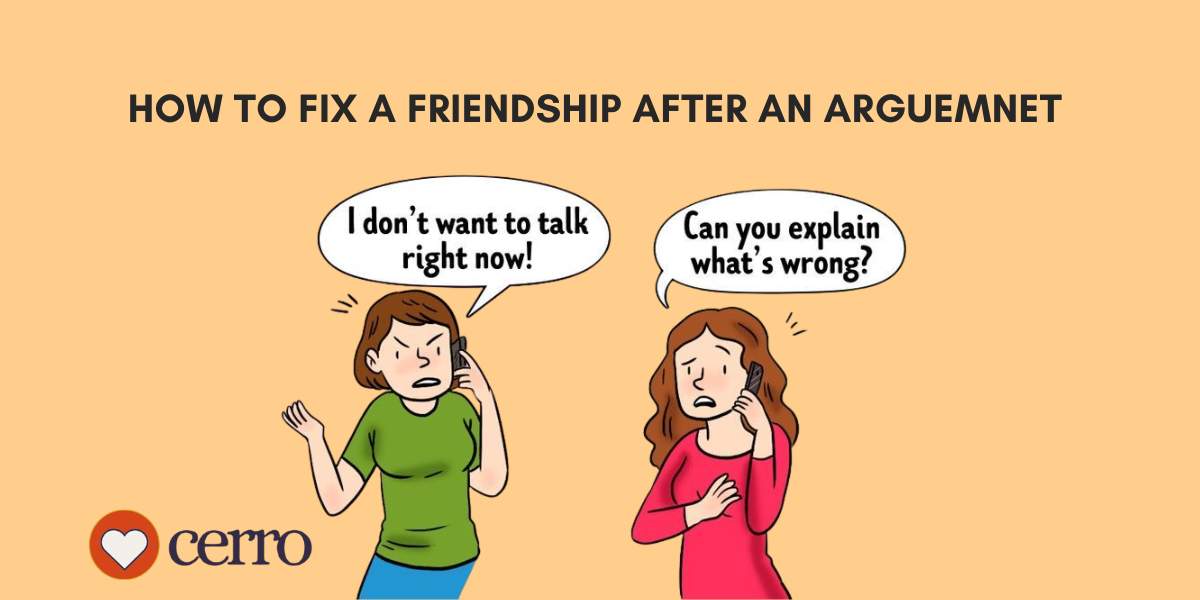
For example, if your arguments often happen through text messages, agree to have important conversations over a call or in person.

If one person needs time to calm down before discussing an issue, learn to respect that.

Fixing a friendship isn’t just about resolving one argument. It’s also about making the friendship healthier going forward.

9. Make a Thoughtful Gesture

Sometimes, after a difficult conversation, a small gesture can help bring back some warmth.

You could invite your friend for lunch, send them something they like, share a funny memory or write them a heartfelt message.

If you want to make your apology more personal, Cerro is another option worth considering.

Cerro has a dedicated apology section where you can create a personalised apology for someone. It’s a thoughtful way to communicate your regret and show that you’ve put extra care into expressing how you feel.

You could use it to make your apology feel more personal rather than sending another ordinary message.

However, remember that gifts and gestures cannot replace an honest conversation. They should complement a sincere apology, not be used to avoid taking responsibility.

10. Reconnect Through the Little Things

Once you’ve addressed the disagreement, don’t feel pressured to make everything perfect immediately.

Start reconnecting naturally.

You could:

  • Check in and ask how their day is going.
  • Share something that reminds you of them.
  • Talk about an interest you both enjoy.
  • Make plans to spend time together.
  • Send them something funny.
  • Bring back a small tradition you used to share.

These little interactions can help restore the comfort and familiarity that made the friendship special.

You don’t have to pretend the argument never happened. Just allow room for positive experiences alongside the difficult one.

11. Rebuild Trust Through Consistency

If the argument involved something serious, one conversation may not be enough to restore the friendship.

Your friend might need time to feel comfortable with you again.

Don’t expect everything to return to normal simply because you’ve apologised.

Be consistent in how you communicate, respect their boundaries and follow through on the things you say you’ll do.

Trust is often rebuilt through small actions repeated over time.

If you want your friend to believe that things will be different, let your behaviour demonstrate that.

12. Don’t Force the Friendship Back to What It Was

Sometimes, people try so hard to repair a friendship that they forget to consider whether both people are actually ready.

Your friend may need more time. They may be willing to forgive you but not immediately return to the same level of closeness.

Allow the friendship to find its natural pace.

You can appreciate the relationship without demanding that everything go back to exactly how it was before the argument.

If both of you genuinely want to continue the friendship, you can build a healthier connection from where you are now.

13. Recognise When a Friendship May Need to End

Not every friendship can or should be repaired.

If the relationship involves repeated disrespect, manipulation, constant conflict or a lack of mutual effort, it’s worth considering whether continuing the friendship is healthy.

You shouldn’t have to be the only person apologising, reaching out or trying to resolve every disagreement.

A healthy friendship requires effort from both sides.

Sometimes, people grow apart or realise that they no longer want the same kind of relationship. That can be painful, but accepting it may be better than repeatedly trying to force a connection that no longer works.

Messages You Can Send to a Friend After an Argument

If you’re unsure how to start the conversation, here are a few messages you can adapt.

When you miss your friend:

“I know things haven’t been great between us, but I honestly miss our friendship. I don’t like that we’ve allowed this situation to create so much distance. I’d really like us to talk and see if we can work things out.”

When you want to apologise:

“I’ve had some time to think about what happened, and I realise I could have handled things better. I’m sorry for my part in the argument. I value our friendship, and I don’t want my actions to make you feel otherwise.”

When you feel misunderstood:

“I think we both got caught up in our emotions, and maybe we didn’t understand each other properly. I don’t want us to keep arguing over something we could talk through. Can we have an honest conversation?”

When you want to reconnect:

“It’s been strange not talking to you like we normally do. I know we had our differences, but I still care about you and would like us to find a way forward.”

When you’re ready to give them space:

“I’ve reached out because our friendship matters to me, but I also understand if you need more time. I won’t pressure you. Just know that I’m open to talking whenever you’re ready.”

Final Thoughts

Arguments don’t automatically mean a friendship has to end. Sometimes, disagreements reveal things that need to be discussed, understood and changed.

If you genuinely value the friendship, be willing to put your pride aside, apologise when necessary, listen to your friend and make an effort to rebuild trust.

You can also find thoughtful ways to express how much the friendship means to you. Cerro’s dedicated apology section offers a personal way to say sorry when you’ve hurt someone and want to make your apology more meaningful.

But remember, repairing a friendship isn’t a one-person responsibility. Both people have to be willing to communicate, respect each other and make an effort.

A disagreement may change a friendship, but with honesty, patience and mutual effort, it doesn’t always have to destroy it.


Please sign in again

For your security, your session ended. Sign in to pick up right where you left off — nothing you've made is lost.